

Teaching today goes far beyond lesson plans and classroom delivery. From designing innovative learning experiences to participating in workshops, research, and curriculum development, teachers are constantly engaging in academic activities that shape their professional identity.
But here’s the real question:
Are these efforts formally recognised in a way that truly advances your career?
This is where Teacher Accreditation steps in, not as a formality, but as an influential bridge between what you do and how your impact is acknowledged internationally. For educators who want to grow beyond the classroom, a clear-eyed look at what accreditation essentially does for your career, your students, and your sense of professional purpose.
Picture this: 2 teachers walk into the same job interview for a senior curriculum role. Both have 5 years of classroom experience. Both are passionate, eloquent, and clearly committed to their students. But one holds a formally accredited teaching qualification from a nationally recognized institution. The other has a degree from a program that never sought accreditation or lost it.
In numerous countries, that single difference regulates who gets the job. In others, it shapes salary bands, promotion eligibility, and even whether a teacher can work across state or national borders. Accreditation, in the world of education, is hardly just a formality. It is often the foundation on which an entire professional journey is built.
57% of school globally report that accredited teacher qualifications are a prime factor in hiring decisions, according to research by the International Task Force on Teachers for Education 2030, a figure that climbs even higher for leadership and professional roles.
Theoretical Activities: The Backbone of Professional Growth
Every teacher invests time in activities that go beyond teaching hours:
- Attending training programs and workshops
- Conducting research or contributing to academic discussions
- Developing lesson plans and curriculum frameworks
- Participating in seminars, conferences, and peer learning
These activities sharpen skills, improve classroom effectiveness, and keep educators updated with modern methodologies. Nevertheless, without structured recognition, much of this effort remains informal.
What Accreditation Really Means and What it Doesn’t?
It’s worth clearing something up early: accreditation is not the same as a teaching license or certification, though the two are often linked. Accreditation is a quality assurance process applied to an educational institution or program.
When a teacher preparation program earns accreditation from a recognized body – such as IEAC, it shows that the program has met rigorous, externally verified standards for curriculum, faculty, student outcomes, and clinical practice. Many educators assume accreditation is just another credential. In reality, it’s much more comprehensive.
This matters for teachers because a degree or diploma from an accredited program carries weight that unaccredited credentials simply don’t. Employers know what the program requires. This holistic approach ensures that teachers are recognised for their complete professional journey, not just isolated achievements.
The Missing Link: Why Recognition Matters?
You may have years of experience and numerous certifications, but how do institutions or global employers assess your overall professional credibility?
This is where a Teacher Accreditation Authority plays a crucial role.
It provides:
- A standardized framework to evaluate teaching competencies
- Recognition of professional development efforts
- Validation of skills and expertise at a global level
In a competitive education landscape, this kind of formal recognition is no longer optional, it’s important.
Scope for Teachers: What Accreditation Unlocks?
Here’s how Teacher Accreditation can transform your career:
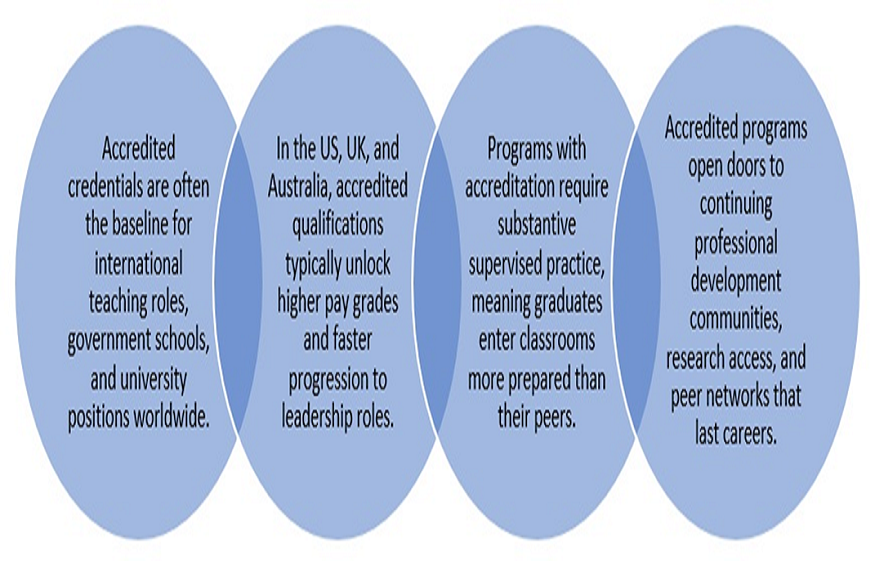
Accreditation frameworks for teachers look different depending on where you are in the world, but the underlying logic is consistent: they exist to protect students, elevate the profession, and create accountability for preparation programs.
Across Southeast Asia, the Middle East, and sub-Saharan Africa, accreditation outlines are evolving quickly. Countries including the UAE, Kenya, and the Philippines have significantly tightened teacher qualification requirements over the past decade, with accreditation playing a growing role in national education reform plans.
- Accredited teachers are frequently preferred for leadership roles such as academic coordinators, mentors, and department heads.
- Accreditation adds credibility when applying for international teaching positions.
- Recognition of your work boosts confidence and validates your expertise.
- Accreditation often connects you with a wider professional community, opening doors to collaboration and learning.
Accreditation and the Rise of Online Teacher Education
One of the most important changes in teacher preparation over the past decade has been the growth of online pathways. For working teachers seeking to deepen their practice, move into leadership, or specialize in areas like special education, STEM, or educational technology, online programs have made advanced study genuinely available.
But not all online programs are formed equal and this is exactly where accreditation becomes critical. A teacher considering a graduate program should verify, before anything else, whether the program holds accreditation from a recognized body in their region or nationally.
This is correspondingly true for internationally recognized programs. The growth of accredited postgraduate pathways has given teachers in countries like India, Nigeria, Brazil, and Indonesia access to internationally recognized credentials without uprooting their careers or families. The credential value, however, depends entirely on whether accreditation is authentic and current.
Teachers who trained in accredited programs report higher confidence in their pedagogical practice, stronger mentorship during their induction years, and more structured access to continuing professional development. These aren’t small advantages at the start of a career, they compound over decades.
Final Thoughts
Accreditation will not make you a great teacher on its own. That takes experience, reflection, humility, and a genuine investment in your students. However, it generates the conditions in which great teaching is more probable to happen and it safeguards that the credential you earn actually opens the doors you’re aiming for. And that’s precisely what Teacher Accreditation is planned to do. The classroom is where the real work happens. But what happens before a teacher ever walks through that door shapes everything that follows.
Whether you’re a newly graduated educator choosing your first program, a mid-career teacher exploring a master’s pathway, or a school leader advising your staff on professional development, accreditation deserves to be near the top of your checklist.